
The Simulation
Find out now,
not on test day.
A full-length NREMT simulation at your level, in every format the Registry uses. You get a Readiness Report that says which content areas, which question formats and which step of your reasoning are costing you points — and what to do about each one.
One-time purchase, no subscription. We email you when your Readiness Report is ready to read in your portal.
What you actually sit
- EMT
- 124 questions, 37 of them beyond multiple choice
- AEMT
- 135 questions, 53 of them beyond multiple choice
- Paramedic
- 149 questions, 62 of them beyond multiple choice
- One sitting, full length
- Not a twelve-question taster. You sit the whole paper at your level in one go, which is the only way the timing tells you anything.
- Every format the Registry uses
- Multiple choice, multiple response, build list, drag and drop, ordered bow-tie and hot spot — so you find out which formats cost you points before the real thing does.
- A written rationale on every item
- Not just the letter. Why the right answer is right, and why the one you picked was the thing you would genuinely do — only not first.
- Scored three ways
- By content area, by question format, and by clinical-judgment step. Three views of one sitting, because “68%” tells you nothing about what to do on Monday.
The report itself
Not a score out of a hundred. Three views of the same sitting, each answering a different question about why the points went missing.
On a phone, drag a chart sideways to read it.
Where the points are
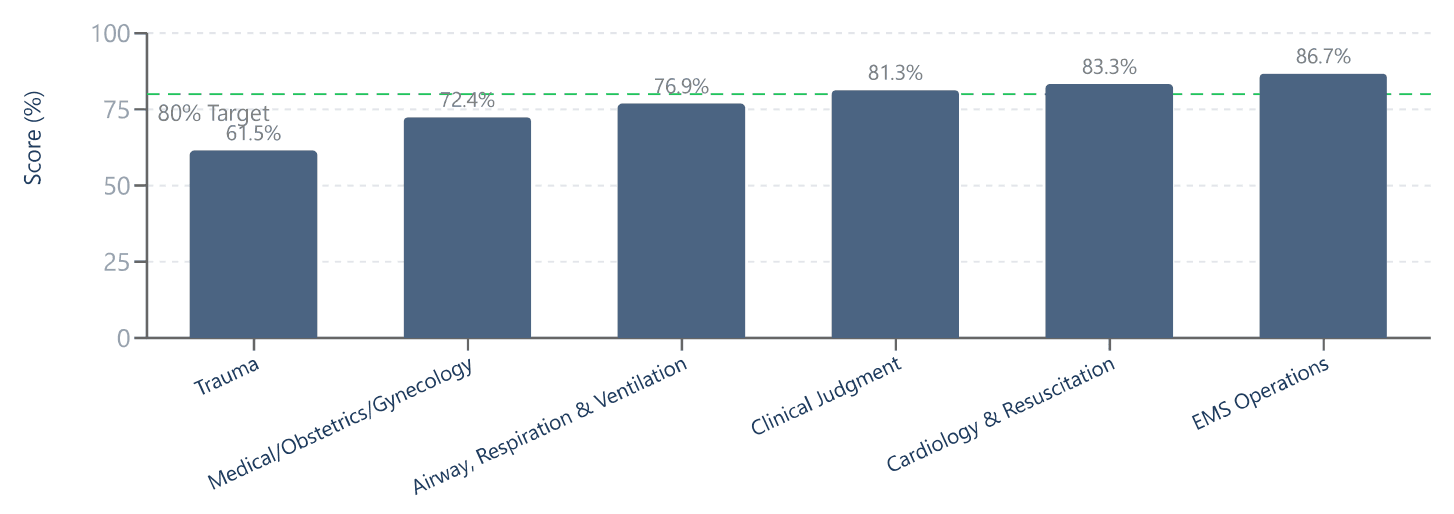
Every Registry question belongs to one of six content areas. The report scores all six and sorts them weakest-first against the 80% line. The shortest bar is where an hour of study buys the most.
And whether it's the format
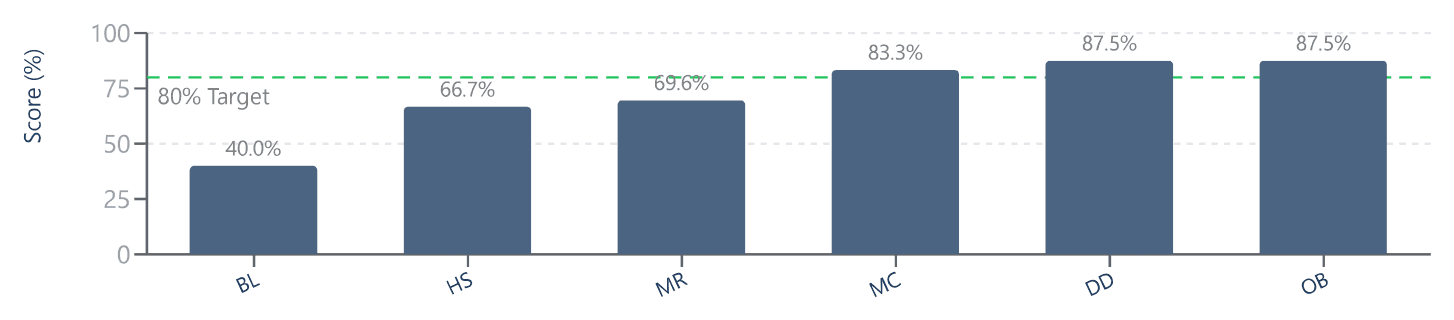
The same answers, scored again by question format — build list (BL), hot spot (HS), multiple response (MR), multiple choice (MC), drag and drop (DD), ordered bow-tie (OB). A low format score next to strong content scores means the gap is mechanics, not knowledge.
And where the reasoning breaks
Clinical judgment is the most heavily weighted area of the AEMT and Paramedic exams, and its questions are built on six cognitive steps: recognize cues, analyze cues, define the hypothesis, generate solutions, take action, evaluate. The radar shows which step in the chain gives way — a different question from which topic you are weak in.
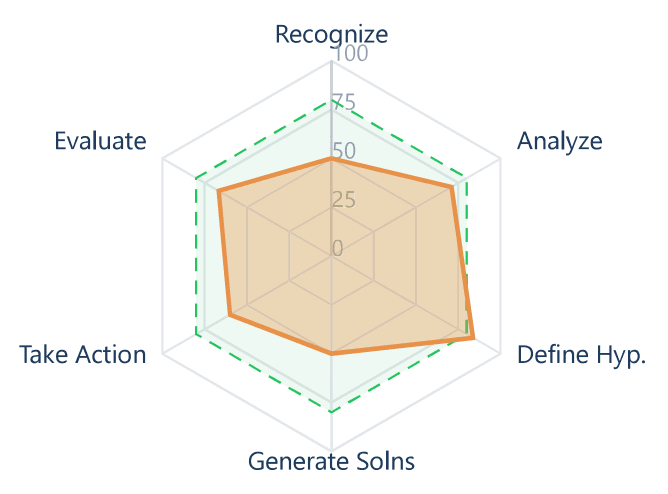
Real charts from a de-identified Readiness Report — a different candidate from the worked example above. Only the chart graphics are published; the written analysis and the prioritized study plan come with the report. You can buy the Simulation on its own, and a one-on-one session with JP includes one.
Read one for yourself
The same attempt, from four angles. Switch between them — that is the argument for sitting one, and it is easier to see than to describe.
Intake · Paramedic Simulation
149 items · 112 correct · 75.2% overall
The same attempt, four ways. Switch between them — the story is usually clearer from one angle than another.
- Trauma4 / 955.6%
- Cardiology & Resuscitation7 / 1861.1%
- Medical / OB / GYN9 / 3976.9%
- Clinical Judgment12 / 5377.4%
- Airway, Respiration & Ventilation3 / 1580.0%
- EMS Operations2 / 1586.7%
Weakest two are Trauma and Cardiology — but they are also the two smallest slices of this exam, so a few items swing them hard.
- Generate Solutions16 / 3857.9%
- Take Action24 / 7166.2%
- Recognize Cues7 / 2673.1%
- Analyze Cues13 / 6178.7%
- Define Hypothesis7 / 4484.1%
- Evaluation2 / 1485.7%
Items carry more than one step tag, so tags total more than items. You read the scene fine. It slips at Generate Solutions — you know what is wrong, and the set of actions still does not come together in the right order.
- Options Box3 / 757.1%
- Multiple Response6 / 1560.0%
- Build List3 / 862.5%
- Drag and Drop3 / 1070.0%
- Multiple Choice22 / 10478.8%
- Graphical0 / 5100.0%
Multiple choice is carrying the score. Every format that makes you assemble an answer — Options Box, Build List, Multiple Response — sits lower. Same weakness as the CJ view, seen from a different angle.
| Content area | Recog. | Analyze | Define | Generate | Action | Eval. |
|---|---|---|---|---|---|---|
| Trauma | 67% | 60% | 80% | 33% | 50% | 100% |
| Cardiology | 71% | 64% | 75% | 42% | 58% | 80% |
| Medical / OB | 80% | 79% | 86% | 61% | 71% | 86% |
| Clinical Judgment | 73% | 81% | 88% | 58% | 68% | 85% |
| Airway | 83% | 80% | 90% | 70% | 79% | 100% |
| EMS Operations | 88% | 86% | 92% | 75% | 84% | 100% |
The whole Generate column is soft regardless of content area. That is the pattern worth an hour, not the one weak domain.
Illustration only — a worked example, not a real candidate and not an NREMT document. Content areas, clinical-judgment steps and item types follow the Paramedic and AEMT test plans; the EMT exam uses its own task-based domains.
How it runs
Buy at your level
EMT, AEMT or Paramedic. One payment, no subscription, and nothing renews.
Sit it in one go
Full length, on a clock. Sitting it in pieces across a week tells you what you know; sitting it whole tells you what happens to you at question 90.
Read the report
Your scored answers become a personalized Readiness Report. We check it before release, then email you a link to read it in your portal.
What it is not
- Not affiliated with, endorsed by, or connected to the NREMT.
- The real exam is computer-adaptive and reports a scaled ability estimate. This reports percent-correct by domain, format and reasoning step — useful for deciding what to study, not a prediction of your exam result.
- No pass guarantee, no pass rate, no score promise. Be careful with anyone who offers one.
Sit one at your level
Booking one-on-one time with JP? A session already includes one — JP reads your report before you meet, so don’t buy it twice.